

The AI Delegation Lifecycle
Your Team Has AI Outputs. Where Are the Decisions?

Hello everyone!
Your team ships AI outputs that nobody fully trusts; you needed to be quick, and “dirty” tagged along. Too bad, that that ungoverned automation becomes AI debt when a stakeholder asks who owns it.
But do not despair: The AI Delegation Lifecycle turns skills you already use into six decisions you can apply this week to govern that work and prove it, audit-ready and suited for agent harnesses.
🎓 🇬🇧 AI4Agile Online Course v3—Waitlist Open: July 20— $149
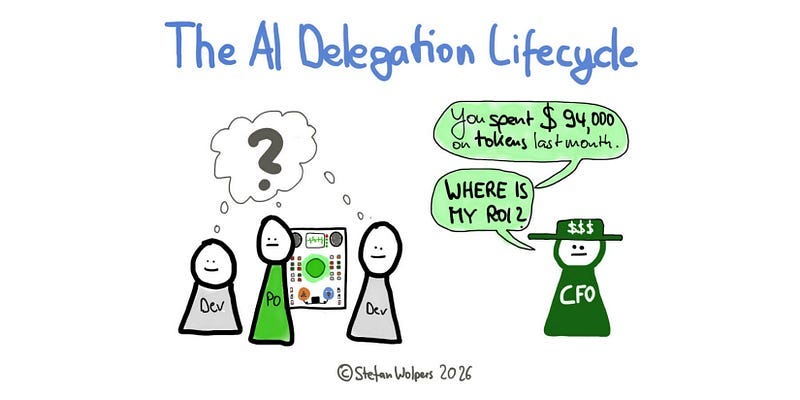
Sooner or later, the CFO will ask what your AI use actually returns. “It saves me time” will not survive that meeting.
The first wave of AI adoption rewarded practitioners who learned to prompt. That skill still matters, and this course still teaches it. The second wave rewards something rarer: people who can turn individual AI use into knowledge that survives departures, spend that can be explained and steered, and output that organizations can trust. That work is process design and change management. You have been doing both for years, on harder problems than this.
The AI 4 Agile Online Course v3 is in English. 🇬🇧
What You Will Get:
✅ 16+ hours of self-paced video modules ✅ A cohort-hardened, proven course design ✅ Learn to 10x your effectiveness with AI; your stakeholder will be grateful ✅ Apply AI to classic use cases of “Agile” ✅ The A3 Framework, A3 Handoff Canvas, AI Definition of Done, and Delegation Retrospective as working handouts ✅ The complete MegaBrain.io case package across both acts ✅ All texts, slides, prompts, graphics; you name it ✅ Access custom GPTs, including the “Scrum Anti-Patterns Guide GTP” ✅ Guaranteed: Lifetime access to v3 ✅ AI4Agile Foundation Certificate: 40 questions in 45 minutes.

👉 Please note: The course will be available for $149 from July 20-27, 2026! (After that, it's $249 again.) 👈
🎓 Join the Waitlist and be first to know: AI4Agile Online Course v3.
🎓 Join Stefan in one of his upcoming training classes!
Popular Traps When Creating AI Output
All teams can show you what their AI produces: status reports sent without anyone touching them, release notes drafted in seconds, a customer-facing FAQ that updates itself. Far fewer teams can answer the question posed by a prospective customer or by compliance: how do you govern your own internal AI use? Often, in the frenzy past to make of AI, nobody decided.
Outputs without decisions are expensive as nobody:
Decided that the status report should run unattended
Wrote down what a good output looks like,
Analyzed the effects of a recent model change, or
Checked last month whether it still produces one.
The work grew that way, one helpful shortcut at a time, until it became a system nobody could explain, and nobody owned. As we know, complex systems always start as complicated systems that, at least to some people, still seem understandable.
That approach of avoiding the creation of that gap, or “evolution”, is to address one decision at a time systematically. I call the practice the Delegation Lifecycle, and you already have most of the skills it requires.
How Outputs Pile Up Without a Single Decision Behind Them
The mechanism is ordinary yet still a shortcut: a Scrum Master pastes Retrospective data into ChatGPT to save 20 minutes. Next Sprint, the team does it again, as it worked the first time. By the third month, the summary goes straight into the team wiki, and nobody reads the raw notes anymore. The team charter does not cover it, but it is convenient; “accepted” as an amendment to the working agreement by not opposing it. The shortcut became infrastructure while everyone was busy delivering.
Now multiply that by every person on the team and every task an AI can touch. You get what I call AI debt: a pile of useful, undocumented, unowned automation that works right up until the moment someone asks who is responsible for it. The “we ship it now and fix it later” habit that got you through the funding round, the launch, the reorg, and the last crisis in general, becomes the liability that shows up the moment you least expect it.
The problem is not that the team uses AI, but that it uses AI without deciding which decisions belong to it. Agile practitioners are good at making decisions. We make working agreements, set acceptance criteria, run Retrospectives, and refine backlogs. The Delegation Lifecycle takes those habits and points them at the work you have started handing to a model.
What Counts as Delegation in the Delegation Lifecycle
First, a boundary, because not every AI interaction needs governing. By delegated work, I mean recurring work in which an AI output is incorporated into a team artifact, stakeholder communication, operational workflow, or customer-facing surface. Asking a model for five ideas before you write the update yourself is not delegation. That is assistance, and it needs prompt discipline, a skill, but not a governance record. The model drafting the update from your tracker every Friday is a form of delegation. And so is sending it without a human in the loop. The lifecycle applies when AI use becomes recurring, consequential, externally visible, or embedded in how the work runs. Not every prompt needs a record, but every delegated workflow does.
🎓 🇬🇧 AI4Agile BootCamp #8, August 27 — September 17, 2026
The job market’s shifting. Agile roles are under pressure. AI tools are everywhere. But here’s the truth: the Agile professionals who learn how to work with AI, not against it, will be the ones leading the next wave of high-impact teams. Therefore, Stefan created the AI4Agile BootCamp.
So, become the professional recruiters‘ first call for „AI‑powered Agile.“ Be among the first to master practical AI applications for Scrum Masters, Agile Coaches, Product Owners, Product Managers, and Project Managers.

Learn more: AI4Agile BootCamp #8, August 27 — September 17, 2026.
Customer Voice: Ilya Zaytsev, Leading Agility at HUGO BOSS: “Last week, I finished the 𝗔𝗜 𝗳𝗼𝗿 𝗔𝗴𝗶𝗹𝗲 𝗣𝗿𝗮𝗰𝘁𝗶𝘁𝗶𝗼𝗻𝗲𝗿𝘀 course. And I’m mutating… It started on the train. I was scrolling through my messages, half-distracted, when a newsletter from Stefan Wolpers popped up. Stefan, a deep thinker with a hands-on attitude, was launching a new course. A pilot cohort. The mission: explore how AI can actually support us as agile practitioners. I couldn’t resist. I tapped: “𝘚𝘪𝘨𝘯 𝘶𝘱”. What followed were four bi-weekly sessions. Four intense afternoons. Full of exploration, experimentation, and practice. […] At the beginning, Stefan said that 𝘫𝘶𝘴𝘵 𝘴𝘪𝘨𝘯𝘪𝘯𝘨 𝘶𝘱 𝘢𝘭𝘳𝘦𝘢𝘥𝘺 𝘱𝘶𝘵𝘴 𝘶𝘴 𝘢𝘩𝘦𝘢𝘥 𝘰𝘧 𝘮𝘢𝘯𝘺 𝘱𝘳𝘢𝘤𝘵𝘪𝘵𝘪𝘰𝘯𝘦𝘳𝘴. That sounded like a big statement. But somewhere along the way, I noticed a shift… an emerging superpower in how I approach my tasks with AI.⚡And now, as my AI-mutation continues, I catch myself wondering: 💭 𝘏𝘰𝘸 𝘥𝘰 𝘐 𝘶𝘴𝘦 𝘈𝘐 𝘵𝘰 𝘴𝘢𝘷𝘦 𝘵𝘩𝘦 𝘢𝘨𝘪𝘭𝘦 𝘸𝘰𝘳𝘭𝘥?..
One Decision, Six Stages
Take a single piece of work your team has delegated to AI. Not the whole AI strategy. One task: the status report, the test generation, and the first-draft release notes. That one decision has a complete path, from “should AI touch this at all” to “what do our records prove when someone asks?”
The Delegation Lifecycle places a decision at each of the six points along that path:
Decide
Question it answers: Should AI touch this work, and how autonomously?
Agile skill you already have: Decision-making with explicit categories.
Route & Boundaries
Question it answers: Which model, tool, environment, data boundary, and sufficiency bar are appropriate?
Agile skill you already have: Acceptance criteria and process design.
Hand Over
Question it answers: How does the work transfer, and who owns it?
Agile skill you already have: Working agreements.
Define Done
Question it answers: What must be true before the output leaves the team, and how is it evaluated?
Agile skill you already have: Definition of Done.
Inspect
Question it answers: Is the delegation still safe and useful?
Agile skill you already have: Retrospective facilitation.
Roll Up
Question it answers: What evidence can we show the people who ask?
Agile skill you already have: Stakeholder communication.
Before the first stage, one rule sets up the rest. The A3 Framework is the entry gate:
Assist when AI supports human judgment, and you own the outcome,
Automate when AI executes a bounded task under human-owned responsibility, and
Avoid when the work is too consequential, ambiguous, or sensitive to hand over.
If you followed my work here on the blog or took the earlier version of my AI4Agile course, you already use it. A3 decides whether work enters the lifecycle at all; the six stages sketched above govern what happens once it does.
Stage 1, Decide: Should AI do this work, and at what level of autonomy? The skill underneath is decision-making with explicit categories. Where teams get stuck: Assist work quietly becomes Automate work when the review habit disappears. You start by checking every output, then most of them, then none, and nobody decided that on purpose.
Stage 2, Route & Boundaries: Which model, tool, and environment run this, what data may enter, and what counts as good enough? Not every task needs your most expensive model, and not every task can run on your cheapest. Model routing means designing the process and acceptance criteria for model, tool, and data choices. The skill is the one you use every time you define “done” for a Product Backlog item. Where teams get stuck: they default to the priciest model for everything, never set a sufficiency bar, and then cannot explain the monthly bill. A cost nobody can account for, better: a low return on invested tokens, is a Stage 2 failure.
Stage 3, Hand Over: How does the work transfer, and who owns it? Task split, owner, inputs, outputs, validation, stop rules, and a record: this is a working agreement, written for a collaborator who happens to be a model. The skill is the same one you use to set team norms. Where teams get stuck: the handoff lives in one person’s head, and no human owner is named. When that person changes teams or leaves, the system leaves with them. Without stop rules, nothing halts the work when the output starts drifting.
Stage 4, Define Done: What must an AI-assisted output meet before it leaves the team? Stage 3 is how the work transfers; Stage 4 is the release gate it has to pass: the verification level, provenance disclosure, data hygiene, and the sufficiency tier from Stage 2. This is your Definition of Done, extended to work that a model touched. Where teams get stuck: “looks good” becomes the only “standard.” Approval gets mistaken for review. Someone clicks send on a procurement email the model wrote after skimming it, and now the team’s name is on a claim nobody verified. Approval is not review, and once an external audience is involved, that gap is what throws your team under the proverbial bus.
Stage 5, Inspect: Is the delegation still working, or has it drifted? This is a Retrospective focused on delegated work rather than the team:
Has the output quality slipped?
Has Assist crept into Automate?
Admittedly, applying “evals” sounds fancier, but the skill is Retrospective facilitation, which you run every Sprint. Inspection does not mean reviewing every output forever. It means agreeing on a sampling rate, the drift signals worth watching, and the trigger that brings the work back under tighter human review. Where teams get stuck is a set-and-forget mentality: Nobody scheduled the inspection, so the drift compounds unseen until it becomes an incident.
Stage 6, Roll Up: What does all of this prove to the people who ask? Leadership, enterprise procurement, and increasingly, regulators want evidence of controlled AI adoption. The skill is stakeholder communication. This stage needs no separate governance artifact. The records from Stages 1 through 5 should already aggregate into what those people ask for: a delegation inventory, an autonomy distribution across Assist and Automate, and an inspection trail. Where teams get stuck is in governance theater. They build a separate leadership deck full of confident claims, disconnected from what the team actually does, and a single sharp question from a CFO collapses it.
The Stages of the Delegation Lifecycle Are a Loop, Not a Checklist
The six stages are a teaching order, not a strict sequence. In practice, your team will agree on the Definition of Done while filling out the A3 handoff canvas, and a finding from an inspection will send a task straight back to Stage 1 for re-classification. That is the system working, not failing.
The stages also depend on each other. A Stage 1 decision that never gets inspected becomes the most dangerous kind of automation: confident, unattended, and unowned. A Definition of Done with no handoff behind it has no teeth, because nobody agreed on who applies the standard or when. Just count how many of these six stages your team has a real decision behind right now; it will make a good starting point for a team discussion on how you are using AI at the moment.
Two points on the path are deliberately set to have no artifact. Before Stage 1 sits, know which work your team does, at what frequency, and at what stakes, which is a forensic analysis of your own workflow. Around all six sits your AI working agreement, the team norm layer. Neither needs a new canvas. The AI Delegation Lifecycle adds a document only where a recurring decision genuinely had no home.
Why This Is Not Optional Anymore
The approach the Delegation Lifecycle proposes is not just about internal hygiene. AI use is moving from personal productivity into organizational accountability. Since February 2, 2025, Article 4 of the EU AI Act has required providers and deployers to ensure a sufficient level of AI literacy among staff and others operating AI systems on their behalf. (Which, interestingly, seems to be largely ignored by many players.) Enforcement through national market surveillance authorities will take effect on August 3, 2026.
NIST organizes AI risk management around the four steps: govern, map, measure, and manage. Anthropic’s first Economic Index found that real-world Claude usage already splits between augmentation and automation: 57% augmentation, 43% automation. The practical question underneath it all is simpler: can you show the decisions behind the work you delegated?
The Roll-Up Is the Quiet Payoff
Most teams miss the byproduct of every stage, producing a valuable record as part of normal use:
The A3 decisions become a portfolio of what you deliberately automated, assisted, and kept human.
The routing records become AI spend by task and tier, with a reason attached.
The Definition of Done sign-offs and inspection logs serve as an audit trail of controlled, inspected adoption.
Nobody fills in an extra report: operational work generates governance evidence as it runs.
So when a prospect asks, “How do you govern your own internal AI use?” the team running this lifecycle does not shrug. It answers with its records. That is the difference between a team that merely uses AI and a team that can be trusted with it, and that trust is becoming a line item in enterprise procurement.
What to Do Monday
Pick one task your team has handed to an AI. Just one. Walk it through the six questions out loud in your next Retrospective: did we decide this, who owns it, what does done mean, when did we last check it, and what would we show someone who asked. I guess that you will find at least one stage where the honest answer is “nobody decided that.” That is your starting point: adopt one stage at a time, wherever your pain is sharpest. Knowledge that walked out with a departing colleague points to Stages 3 and 4. A token bill nobody can explain to the CFO points to Stage 2. An output that embarrassed you in front of a stakeholder points to Stages 4 and 5.
Conclusion
In version 3 of the AI4Agile online course, the release date is July 20, 2026, I turn this lifecycle into a working method teams can apply immediately: how to decide what to delegate, how to hand it over safely, how to inspect drift, and how to produce the evidence without building a governance theater. If you want the method and not just the introduction, join the waitlist, and I will keep you posted on v3 topics with sneak previews and inform you the moment it goes live.
Which of the six stages does your team actually have a decision for? I am curious, and I suspect the answer is fewer than you would like.
Delegation Lifecycle — Related Articles
AI4Agile Online Course v3 — Release on July 20, 2026
Assist, Automate, Avoid: How Agile Practitioners Stay Irreplaceable with the A3 Framework
The A3 Handoff Canvas: Six Questions That Turn AI Delegation Into a Repeatable Workflow
The A3 Framework: Assist, Automate, Avoid — A Decision System for AI Delegation
Three AI Skills to Sharpen Judgment
No More Cheap Claude: Four First Principles of Token Economics in 2026

👆 Stefan Wolpers: The Scrum Anti-Patterns Guide (Amazon advertisement.)
📅 Training Classes, Meetups & Events 2026
Upcoming classes and events:
🖥 💯 🇬🇧 July 1 — Meetup: HoA 75: Token Economics (English)
🖥 💯 🇬🇧 July 20 — Self-Paced Online Course: AI 4 Agile Course v3 — Master AI for Agile Practitioners (English; Self-paced Online Course)
🖥 🇩🇪 August 25–16, 2026 — Live Virtual Class: Professional Scrum Product Owner Training (PSPO I; German)
🖥 💯 🇬🇧 August 27-September 17 — Live Virtual Cohort: AI4Agile BootCamp #8 (English)
👉 See all upcoming classes here
📺 Join 6,000-plus Agile Peers on YouTube
Now available on the Age-of-Product YouTube channel to improve learning, for example, about AI’s Labor Market Impact:
Stop Writing Prompts. Let AI Do It for You — Hack #01, AI4Agile Online Course v2.
Check Your AI’s Plan Before — Hack #7, AI4Agile Online Course v2.
From Product Requirements to Experiments to Learnings — Supported by Generative AI.
Never Accept an LLM’s First Offer — Improve GenAI’s Usefulness w/ Feedback Loops and Challenges.
🎓 Do You Want to Read More Like This?
Also:
📅 Join 6,000-plus peers of the Hands-on Agile Meetup group
🐦 Follow me on Twitter and subscribe to my blog, Age of Product
💬 Alternatively, join 20,000-plus peers of the Slack team “Hands-on Agile” for free.
The "Assist quietly becomes Automate when the review habit disappears" line is the one I'd underline. I see the same drift with classic RAG status reports: nobody decided the green light could go out unreviewed, the habit just eroded one busy Friday at a time.
Your point that approval is not review is where most of the damage hides. Where I'd push: in smaller orgs without a real Retro or DoD to begin with, Stage 5 has nothing to stand on, so the entry question becomes whether a review ritual even exists to extend.