

The AI Precision Anti-Pattern
Stop Using LLMs for Problems That Demand Correct Answers

Hello everyone!
Here’s another one for your collection:
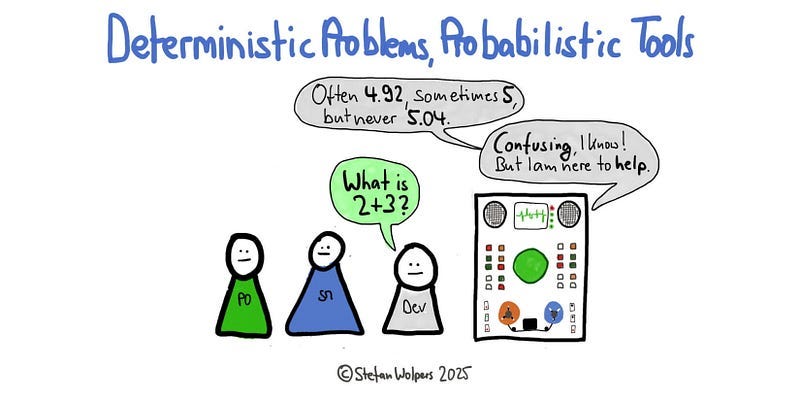
The AI Precision Anti-Pattern, where organizations wield LLMs like precision instruments when they’re probabilistic tools by design. Sound familiar? It’s the same pattern we see when teams cargo-cult agile practices without understanding their purpose.
LLMs excel at text summarization and pattern recognition in large datasets, which helps analyze user feedback or generate documentation drafts, but can they be used for deterministic tasks like calculations? If you are not careful with matching your problem to the right tool, you end up building issues of all kinds into the foundation of your product.
What can you do about it? Spoiler alert: The fix isn’t better prompting, but architectural discipline and tool-job alignment.
🎓 🇬🇧 🤖 The AI 4 Agile Online Course at $129 — October 13, 2025
I developed the self-paced AI 4 Agile Online Course for agile practitioners, including Product Owners, Product Managers, Scrum Masters, Agile Coaches, and delivery professionals who want to integrate artificial intelligence into their workflows with clarity, ethics, and purpose.
You don’t need to become an AI expert. However, you do need to understand how LLMs like ChatGPT, Claude, or Gemini can support real agile work and where their limitations lie. Like Jim Highsmith said, AI isn’t just a tool, but a new context for agility.
This course shows you how to do precisely that.
What’s Included:
10+ hours of self-paced video modules
A cohort-hardened, proven course design
Learn to 10x your effectiveness with AI; your stakeholders will be grateful
Delve into classic agile use cases of AI
Help your team create more customer value
All texts, slides, prompts, graphics; you name it
Access custom GPTs, including the “Scrum Anti-Patterns Guide GTP”
Enjoy community access for peer learning
Guaranteed: Lifetime access to all course updates and materials; there is a lot more to come
Certificate of completion.

👉 Please note: The course will only be available for sign-up at $129 until October 20, 2025! 👈
🎓 Join the Waitlist of the AI 4 Agile Online Course Now: Master AI Integration for Agile Practitioners — No AI Expertise Required!
🎓 Join Stefan in one of his upcoming Professional Scrum training classes!
Your LLM Isn’t Broken; You’re Using It Wrong
There’s a new and tempting anti-pattern emerging in product development: using generative AI for tasks that require 100% accuracy and consistency. While LLMs are potent tools for ideation, pattern identification, or summarization, treating them like calculators or compilers is a misuse of the technology.
This approach introduces systemic unreliability into your product and is a misunderstanding of what the tool is designed for. For any deterministic problem, this strategy is not just inefficient but also a direct path to failure.
The Core of the Anti-Pattern
At its heart, this anti-pattern stems from a fundamental mismatch between the problem and the tool:
A deterministic problem has one, and only one, correct answer. Given the same input, you must get the exact same output every time. Think of compiling code, running a database query, or calculating a sales tax. It’s governed by strict, verifiable logic.
A probabilistic system, like an LLM, operates on statistical likelihood. It predicts the most plausible sequence of words based on its training. Its goal is to generate a convincing, human-like response, not a verifiably true one.
Using an LLM for a deterministic task is like asking an author to file your taxes. You’ll probably receive a document that is well-structured and sounds authoritative. However, the probability of it being numerically correct and compliant with tax law is low. The same effect shows when you use a tool built for creativity and fluency to do a job that requires rigid precision.
Failure Modes You Will Encounter
When teams fall into this trap, the consequences manifest in predictable ways that undermine product quality and user trust:
Plausible but Incorrect Outputs (Hallucinations)
The most common failure is when the LLM confidently provides an incorrect answer. It might generate code that is syntactically perfect but contains a subtle, critical logic flaw. Or, it might answer a user’s calculation query with a number that appears correct but is factually incorrect. The model isn’t lying; it’s just assembling a statistically probable sequence of tokens, without any grounding in factual accuracy.
Inconsistent Results
A core principle of any reliable system is repeatability. An LLM, by design, violates this. Due to its probabilistic nature and sampling techniques, asking the same question multiple times can yield different answers. This level of unreliability is unacceptable for any process that requires consistent, predictable outcomes. You cannot build a stable feature on an unstable foundation.
Unverifiable “Reasoning”
When an LLM explains its “chain-of-thought,” it’s not exposing a formal proof. It’s generating a narrative that explains its probabilistic path to the answer. This justification is itself a probabilistic guess and cannot be formally audited. Unlike a compiler error that points to a specific line of code, an LLM’s explanation offers no guarantee of logical correctness.
🖥 💯 🇬🇧 AI for Agile BootCamp Cohort #2 — September 15 — October 6, 2025
The job market’s shifting. Agile roles are under pressure. AI tools are everywhere. But here’s the truth: the Agile pros who learn how to work with AI, not against it, will be the ones leading the next wave of high-impact teams.
So, become the one who professional recruiters call first for “AI‑powered Agile.” Be among the first to master practical AI applications for Scrum Masters, Agile Coaches, Product Owners, Product Managers, and Project Managers.
Tickets also include lifetime access to the corresponding online course, once it is published. The class is in English. 🇬🇧

Learn more: 🖥 🇬🇧 AI for Agile BootCamp Cohort #2 — September 15 — October 6, 2025.
Customer Voice: “The AI for Agilists course is an absolute essential for anyone working in the field! If you want to keep up with the organizations and teams you support, this course will equip you with not only knowledge of how to leverage AI for your work as an Agilist but will also give you endless tips & tricks to get better results and outcomes. I thoroughly enjoyed the course content, structure, and activities. Working in teams to apply what we learned was the best part, as it led to great insights for how I could apply what I was learning. After the first day on the course, I already walked away with many things I could apply at work. I highly recommend this course to anyone looking to better understand AI in general, but more specifically, how to leverage AI for Agility.” (Lauren Tuffs, Change Leader | Business Agility.)
Use the Right Tool for the Job
The observation that using probabilistic tools to solve deterministic problems is challenging doesn’t mean generative AI isn’t a revolutionary technology. By all means, it excels at tasks involving creativity, summarization, brainstorming, and natural language interaction, proving its worth for agile practitioners daily.
The solution to this fundamental capability-requirement mismatch isn’t to try to “fix” the LLM’s accuracy on deterministic tasks. It’s to recognize the categorical difference between the two problem types and architect your systems accordingly:
For precision, accuracy, and verifiability, rely on deterministic tools, such as spreadsheets, compilers, or database management systems.
Hence, view LLMs as complementary tools, not replacements. The most effective applications will combine the LLM’s pattern-recognition capabilities with traditional, logic-based systems that handle the precise computation and verification.
Consequently, for product and engineering teams, the solution is simple: match the tool to the job. Substituting a deterministic model with a probabilistic model isn’t an innovation; it’s an anti-pattern that introduces unnecessary risk and technical debt into your product.
Conclusion: The Generative AI Precision Anti-Pattern
This Generative AI precision anti-pattern exposes a systemic issue in how we adopt emerging technologies: We rush toward the shiny object without examining our actual constraints.
Just as Scrum fails when teams ignore its empirical foundations, LLM implementations fail when we ignore their probabilistic nature. The organizations thriving with AI aren’t the ones forcing it everywhere; they’re the ones practicing disciplined product thinking. They understand that breakthrough technology requires breakthrough judgment about when not to use it.
📖 Generative AI Precision Anti-Pattern — Related Posts
Meta Prompting: Making AI Your Conversation Partner
Ethical AI in Agile: Four Guardrails Every Scrum Master Needs to Establish Now
Generative AI in Agile: A Strategic Career Decision
Contextual AI Integration for Agile Product Teams

👆 Stefan Wolpers: The Scrum Anti-Patterns Guide (Amazon advertisement.)
📅 Training Classes, Meetups & Events 2025
Upcoming classes and events:
🖥 💯 🇬🇧 September 15–October 6 — Live Virtual Cohort: AI for Agile BootCamp Cohort (English)
🖥 🇬🇧 September 23–24 — Live Virtual Class: Professional Scrum Master — Advanced Training (PSM II; English)
🖥 💯 🇬🇧 October 1–November 12 — Live Virtual Cohort: AI for Agile BootCamp Cohort (English)
🖥 🇩🇪 October 21–22 — Live Virtual Class: Professional Scrum Product Owner Training (PSPO I; German)
🖥 💯 🇬🇧 November 6-December 4 — Live Virtual Cohort: AI for Agile BootCamp Cohort (English)
🖥 🇬🇧 November 10–11 — Live Virtual Class: Professional Scrum Master — Advanced Training (PSM II; English)
🖥 🇩🇪 November 17–18 — Live Virtual Class: Professional Scrum Product Owner Training (PSPO I; German)
🖥 🇩🇪 December 9–10 — Live Virtual Class: Professional Scrum Product Owner Training (PSPO I; German)
🖥 🇬🇧 December 16–17 — Live Virtual Class: Professional Scrum Master — Advanced Training (PSM II; English)
🖥 🇬🇧 December 18 — Live Virtual Class: Professional Scrum Facilitation Skills Training (PSFS; English)
👉 See all upcoming classes here
📺 Join 6,000-plus Agile Peers on YouTube
Now available on the Age-of-Product YouTube channel:
Hands-on Agile #68: How to Analyze Unstructured Team Interview Data with AI.
Hands-on Agile 2025: The 5 Obstacles to Empowered Teams — Maarten Dalmijn
Hands-on Agile 2025: The Top Reasons Why a Product Strategy Fails — Roman Pichler
Hands-on Agile 2025: Taylorism-Lean-Agile-Product Mindset — Jonathan Odo
Hands-on Agile Extra: How Elon Musk Would Run YOUR Business mit Joe Justice
🎓 Do You Want to Read More Like This?
Also:
📅 Join 6,000-plus peers of the Hands-on Agile Meetup group
🐦 Follow me on Twitter and subscribe to my blog, Age of Product
💬 Alternatively, join 20,000-plus peers of the Slack team “Hands-on Agile” for free.